
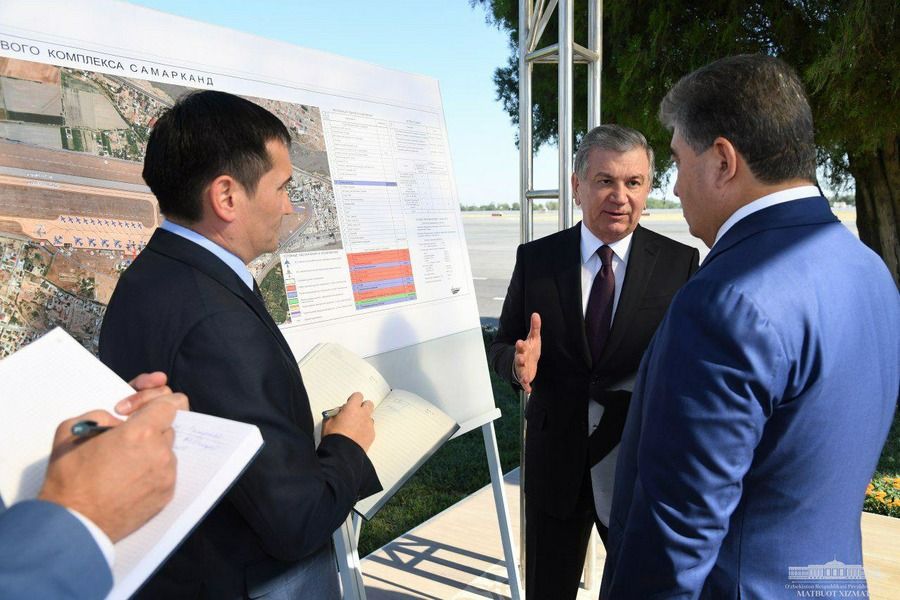
The large-scale reconstruction of Samarkand International Airport has become one of the cornerstone infrastructure projects in the modern history of Uzbekistan's civil aviation. As the country's first modernized airport was officially commissioned on March 18, 2022. Below is a detailed technical review of the project based on engineering blueprints, presentation data, and official design specifications. 1. Comparative Analysis: "Before" vs. "After" Parameter / Facility Before Reconstruction (Legacy Complex) After Reconstruction (New Complex) Passenger Terminal Built in 1967, obsolete facility. Ultra-modern "open book" terminal spanning 40,700 sq. m. Passenger Capacity 350–400 passengers per hour. 1,000–1,200 passengers per hour (up to 2 million annually). Weekly Flights ~40 scheduled flights. Over 120 scheduled flights. Runway Restricted heavy aircraft operations. Fully new ICAO-compliant Code E runway for heavy aircraft.
2. Design and Technical Parameters of Airfield Infrastructure During the modernization of the airfield, special focus was placed on pavement bearing capacity, geometric parameters, and the integration of radio navigation systems. Runway (RWY) The design of the new runway was engineered to ensure the safe operation of wide-body and heavy aircraft. Geometric Dimensions: A new runway (Runway 09/27) was constructed, measuring 3,105 meters in length and 45 meters in width (total width including paved shoulders is 60 meters). Shoulders: Designed with a width of 7.5 meters on each side to prevent soil erosion and foreign object debris (FOD) ingestion into aircraft engines. Pavement Material: High-grade Asphalt Concrete was selected to ensure essential elasticity, required friction coefficient, and surface smoothness. Landing Category: Classified as Code E. Equipped with advanced airfield lighting certified for ICAO Category II precision approach on RWY 09 and Category I on RWY 27. Apron & Aircraft Stands The apron design implemented a clear separation between flexible and rigid pavements based on load distribution patterns. Concrete was selected over asphalt in areas where aircraft park for extended periods with engines off and execute tight turns, as asphalt is susceptible to plastic deformation under static loads. Apron Pavement Material: 100% Cement Concrete. Rigid concrete pavement efficiently distributes static heavy loads imposed by multi-wheel landing gear. Stand Configuration: The apron accommodates simultaneous parking for 24 aircraft. Aircraft Code Separation: 13 stands are allocated for Code E wide-body aircraft (such as Boeing 777, 787 Dreamliner, Airbus A330, A350). 11 stands are designated for Code C narrow-body aircraft (Airbus A320/A321 family, Boeing 737). 3. Radio Navigation and Meteorological Support Flight safety and low-visibility landing operations (during fog or heavy rainfall) are backed by a state-of-the-art radio navigation and landing system: Instrument Landing System (ILS/DME): Co-located ILS and Distance Measuring Equipment installed for both approach directions (RWY 09/27). Radar Control: A new Airfield Surface Movement Radar (ASR) integrated with a Monopulse Secondary Surveillance Radar (MSSR) was installed to ensure precise aircraft tracking within the terminal control area. Meteorological Equipment: Fully automated weather sensor suits measuring runway visual range (RVR), cloud ceiling, and wind parameters in full compliance with ICAO Cat II requirements. 4. Architectural Concept of the New Terminal Enter Engineering, a leading EPC contractor in Central Asia, served as the general contractor, while Air Marakanda was appointed as the operator. The terminal structure features a distinct architectural identity. Measuring 175 meters in width and 25 meters in height, the building resembles an open book—symbolizing the monumental astronomical work of medieval scholar Mirzo Ulugbek, Zij-i Sultani. At night, the terminal's roof lights up with a projection depicting a map of constellations and stars. The terminal is equipped with 4 passenger boarding bridges, ensuring seamless boarding directly from gates to aircraft cabins.